
Klæbu Vicarage
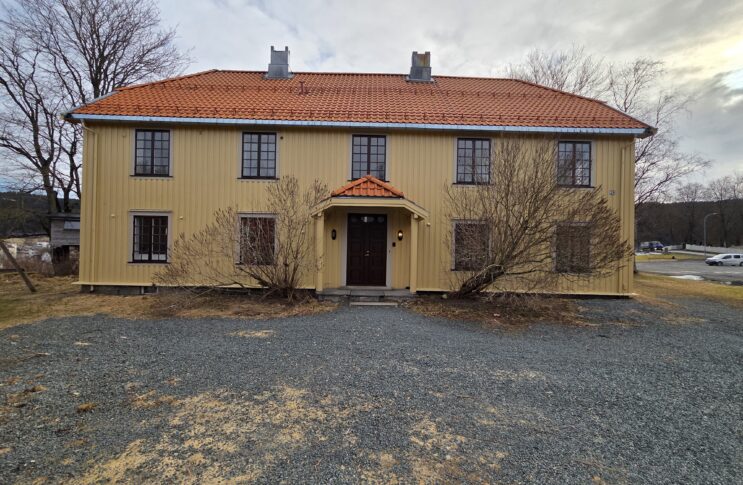
In olden times, Klæbu Vicarage belonged to the By farm. The name By simply means "the farm" and was used to designate particularly good farms with fertile soil. From 1810, parts of the Nyhus and By properties were merged, and the farm was named Nyhus. From the 1700s, Nyhus was a vicarage, and the official name Klæbu Vicarage naturally came into use. The main building was erected between 1830 and 1840, based on the model of the ideal vicarage designs that Sverdrup/Linstow had prepared for the ministry. The building is a large, two-storey log structure with a hipped roof. Between 1897 and 1919, architect G. Arentz drew up several proposals for Klæbu Vicarage. This architect was commissioned by the Ministry of Church Affairs to design vicarages, and was responsible for several in Trøndelag: Meldal Vicarage (1905), Børsa Vicarage, Byneset and Bjugn.
The symmetrical façade of the main building dates from an extension added after 1921. In 2024, the main building was restored to its original colours and given ochre-coloured cladding.
Protected by the Directorate for Cultural Heritage in 1991
- main house, 1837
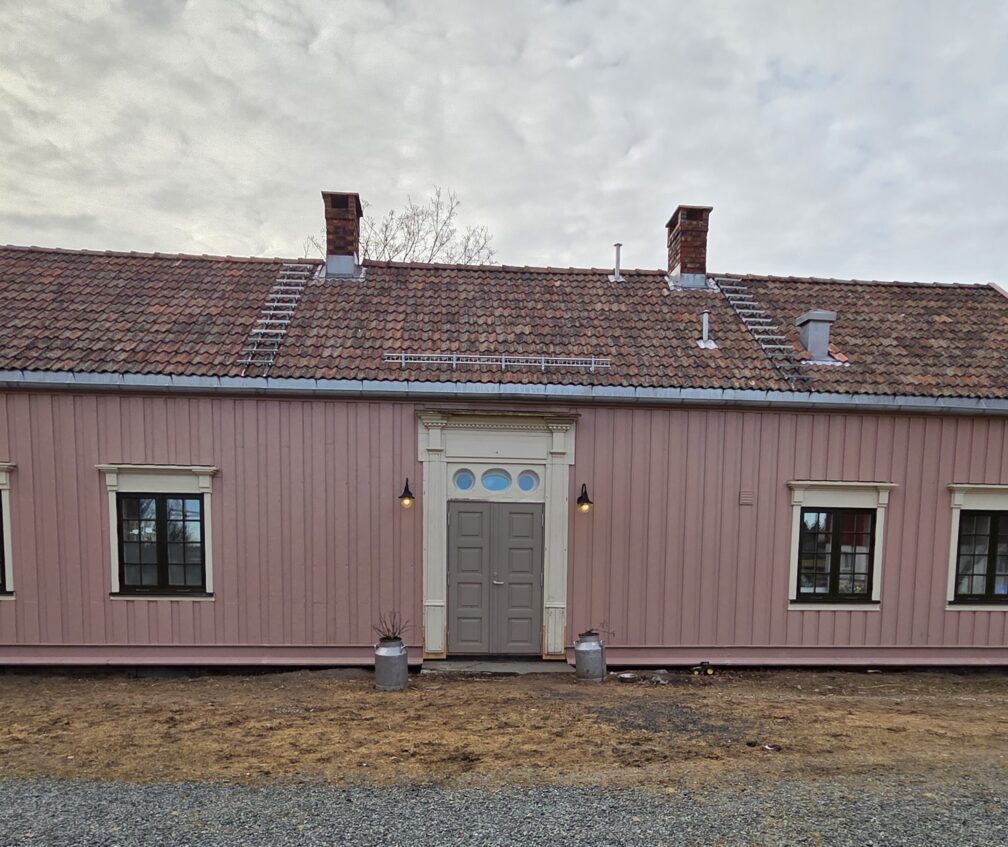
- tenant farmer's residence/manor house
- cookhouse/storage house, built between 1650 and 1750
- storehouse, built after 1759
Originally, the manor room, servants' quarters (1780) and woodshed formed one long, continuous building with different cladding and roof heights. Today, there is no continuous building, but the one old manor room from 1845 stands alone on this farmyard. In 2024, it was restored to its reddish-pink colour and serves as the tenant farmer's residence. The storehouse with its bell tower on the opposite side is thought to have been built shortly after 1759. The cookhouse or storage house is of unknown age. For generations, Klæbu Vicarage has been an official residence, a home and a workplace for priests.
The operation of the farm was separated from the vicarage long ago, and the property is run as a tenant farm, producing grain and sheep.
Restoration of several vicarage buildings
One year after the main house and tenant farmer's residence had been fully rehabilitated, Allstad's building section began restoring the storage house. The storage house was also called the cookhouse and was an important building for preparing food from scratch; it functioned as a rough kitchen. Together with the storehouse, the cookhouse, or storage house, was one of the only buildings saved when the entire farm burned down in 1759. The old floor in the storage house concealed interesting finds, such as old cartridges and ornaments, while the restoration also revealed rot damage and old window openings.
People and memories
In 1814, parish priest Jacob Hersleb Darre travelled from Klæbu to Eidsvoll. He had been selected to represent Søndre Trondhjem County at the Constituent Assembly. He kept a diary of the proceedings, but took little part in the debates except when they concerned the sale of vicarage estates. In retrospect, he himself believed that he could take credit for the fact that the benefice estates (the estates belonging to the parish clergy) were not sold to build up the new country of Norway after its liberation from Denmark. Revenue from the sale of the vicarage estates was to be earmarked for the church and education. This provision was clarified in 1821 (formerly Section 106 of the Constitution)
Darre was not elected to the Extraordinary Storting and did not later become a member of parliament either. For the rest of his working life, he served as parish priest in Klæbu. Of the buildings at the vicarage today, only the storehouse and the cookhouse date from his time.
Some vicarages in the country developed into important institutions in their own right. Klæbu is one example. When Norway began establishing its own educational institutions after gaining independence from Denmark, some vicarages were well suited to becoming teacher-training colleges. Klæbu Vicarage was selected for the Trøndelag region. The teacher-training college, officially called the Seminary, was founded here in 1839. It was run by parish priest Hans Jørgen Darre (1803–1874) From 1890, women could also apply for admission.
More than 1,000 teachers received their education at Klæbu Vicarage before the seminary was moved to Levanger in 1892, where it continued as Levanger Teacher-Training College.