
Asker Vicarage

Asker Vicarage is located just northeast of Asker Church. The old name of the farm was Røyrvin and the history of the farm stretches far back in time. There have been several visible cultural heritage monuments on the property, but today a large burial mound called Prinsehaugen is the most prominent visible remnant from pre-Christian times.
The vicarage was a hub on the route between Drammen and Oslo in the old days. The main building at the vicarage is believed to have been built during the tenure of parish priest Jacob Neumann, who was a pioneer in several areas. He founded the Asker Parish Welfare Association, which later became the forerunner of the Asker Handicraft Association. Today, an association that rents several of the vicarage buildings for its activities. Under Parish Priest Neumann, and later Vogelius, the vicarage was regarded as a model farm.
Several plots have been separated from the vicarage. Among other things, Jansløkka School was built on the vicarage grounds in 1844.
New use
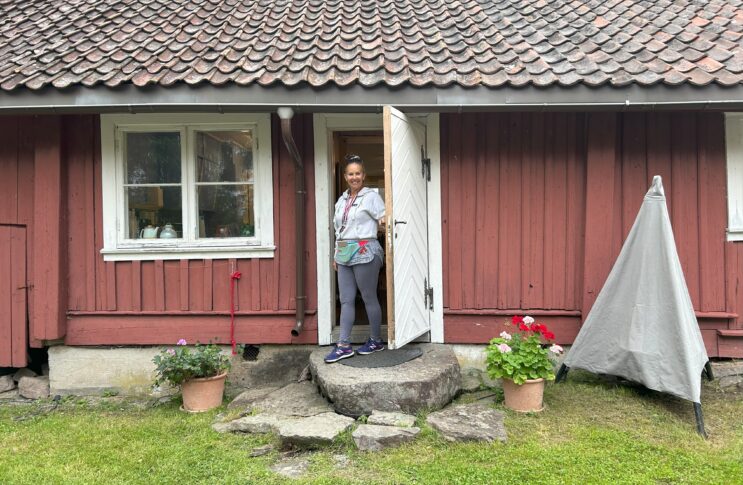
The red, single-storey farmhand's cottage has been a permanent meeting place for Ung Husflid for many years, with Elin Flaaten as the driving force behind the work. In recent years, Allstad has also rented out the main house to the Asker Handicraft Association, which is one of the largest in the country. Looms and sewing machines have been placed in many rooms of the house, and activities take place in the large building several days a week.
The farm building is an L-shaped barn, and in one end Nesbru Upper Secondary School has established a carpentry workshop and provides practical instruction.


Protected by the Directorate for Cultural Heritage in 1991
- Main building 1806–07
- Farmhand's cottage 1800
- Farm building beginning of the 1900s
- Garden pavilion 1806
Asker Vicarage has been a large farm which, ahead of changes of parish priest, has been rehabilitated and upgraded. In 2024, parts of the cladding, as well as timber and window sections, were repaired due to rot damage. In addition, the entire vicarage residence was restored, with the correct colours and exterior cladding painted with linseed oil paint in light ochre.